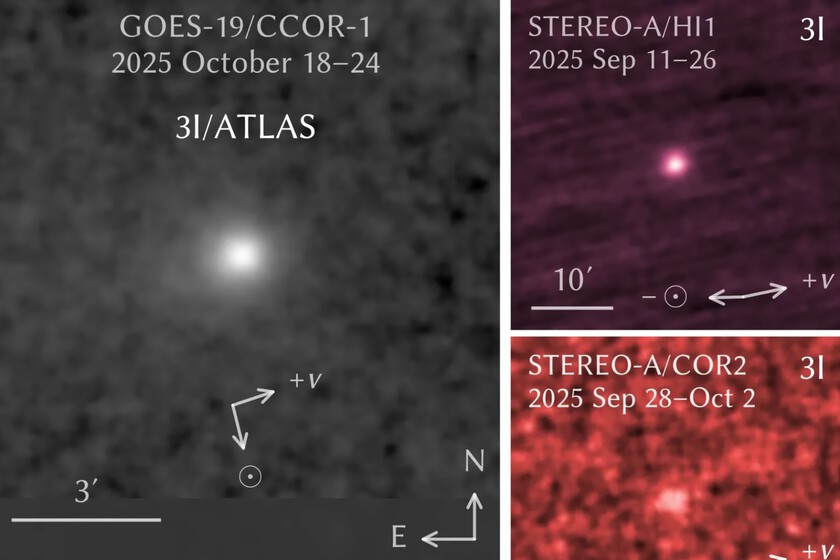
Avi Loeb, a controversial cosmologist at Harvard University, has accused NASA of withholding important data about the 3I/ATLAS interstellar comet and is mobilizing the US Congress to demand its release. But this alleged concealment of evidence is not what it seems.
Haven’t seen a photo in weeks. In a blog post, Loeb decries NASA’s failure to release images of the object taken by the Mars Reconnaissance Orbiter’s HiRISE camera from Mars orbit for weeks. These images, taken between October 2 and 3, when 3I/ATLAS flew within 30 million kilometers of the red planet, according to Loeb, are “extremely valuable” scientific data.
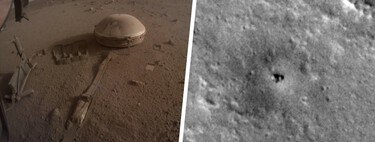
The reason is that they will have a resolution of 30 kilometers per pixel, three times the best available image of an interstellar object taken by the Hubble Space Telescope. This “side perspective” could be important for understanding the object’s geometry and brightness, so Loeb asked US Congresswoman Paulina Luna to request NASA Acting Administrator Sean Duffy to release it.
Explanation. NASA justified the lack of pictures with a very mundane argument: delays caused by the shutdown of the United States government since October 1. NASA is officially “shut down” and 83% of its employees are on unpaid leave due to the lack of agreement in Congress on federal budgets for 2026.
Only the control room of the International Space Station and the operators responsible for the safety of the ships and satellites, as well as a few important workplaces, continue to function. The rest (most of the science, distribution, manual processing, etc.) is on hold.
Why is there such interest in 3I/ATLAS. Comet 3I/ATLAS is the third interstellar object discovered in our solar system. Since its discovery, it has shown rather puzzling behavior, which led Avi Loeb to defend the hypothesis that it could be an artificial extraterrestrial object.
The most recent anomaly occurred near perihelion (the closest point of the orbit to the Sun) on October 29, when 3I/ATLAS glowed bright blue and experienced an acceleration that could not be explained by the Sun’s gravity. Most likely? That the comet degassed as it heated, and the sublimated ice acted as fuel.
If you don’t pay attention to it, you get bored. Loeb estimated the possibility that 3I/ATLAS is a natural object at “less than one part in ten quadrillion”. As evidence, the astronomer points to a trajectory almost perfectly aligned with the plane of the planets, an unusually large mass (to be confirmed), a low water content and a surprising abundance of nickel.
But this is not the first time that Loeb has suggested that the interstellar object is technological and “possibly hostile”. In fact, this is the second time (the first time was from ‘Oumuamua) and we know of only three interstellar objects that have visited our solar system.
The scientific community is not playing along. Compared to Loeb’s hypotheses, the vast majority of astronomers offer much more down-to-earth explanations. The blue glow corresponds to emissions of ionized gas from other active comets. Other physical characteristics could be explained if 3I/ATLAS was the ejection of a piece of an exoplanet from a natural collision far from Earth.
As for the news that NASA has activated its 3I/ATLAS defense protocol, this also has a simple explanation: the International Asteroid Warning Network selected a few days ago to measure the position of an interstellar comet for an astrometric campaign planned from 2024. Not to protect yourself from an alien attack, but to improve measurement methods.
Picture | K. Zhang and K. Datums
In Xataka | The Theory That Says Our Universe Was Created in a Lab: When Science Meets Science Fiction