
Named after NASA’s first female lead astronomer, the “mother of the Hubble Space Telescope,” the new Nancy Grace Rome Space Telescope will have a field of view at least 100 times larger than Hubble’s, and will be able to measure light from a billion galaxies during its lifetime. This observatory will also be able to block starlight to directly observe the planets around them and planetary disks, complete a statistical census of planetary systems in our galaxy, and certainly unravel the mysteries of dark energy.
Construction of this NASA space telescope was recently completed with final assembly operations of its parts in the largest clean room at NASA’s Goddard Space Flight Center in Greenbelt, Maryland, USA.
After the final tests, Roman will be transferred to NASA’s Kennedy Space Center in Florida to prepare it for a launch into space, which will take place from this center between the fall of 2026 and May 2027. The SpaceX Falcon Heavy rocket will send the observatory to its final destination, the L2 Lagrange point of the Sun-Earth system, approximately one and a half million kilometers from Earth.
Observing from space would make Roman very sensitive to the infrared light coming from the farthest regions of space. Combining sharp infrared vision with a panoramic view of space will allow it to peer into a wide range of astronomical phenomena and objects, from dark matter and dark energy to planets outside our solar system and solitary black holes, and conduct research that would take hundreds of years using other telescopes.
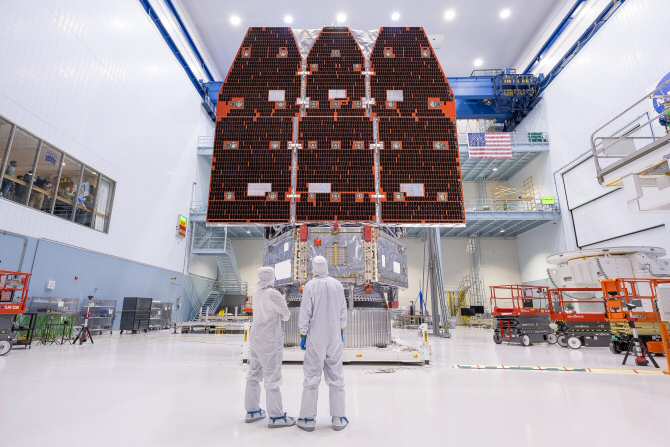
Rome’s Nancy Grace Space Telescope is now fully assembled after the integration of two major segments. (Photo: NASA / Jolearra Tshiteya)
Roman is equipped with two devices: a technological demonstration coronagraph and a wide-field device.
Coronagraph will demonstrate new technologies for direct imaging of planets around other stars. It will effectively block the glare of distant stars, making it easier to recognize the faint glow of the planets orbiting them. The coronagraph aims to photograph the orbital environments of nearby stars in visible light to help detect planets that would otherwise be invisible to other telescopes.
The Wide Field Instrument is a 288-megapixel camera that will reveal countless details of space from our solar system to the edge of the observable universe. With this device, each shot will capture a portion of the sky larger than the visible size of the full moon.
The Roman mission will collect data at a rate hundreds of times faster than NASA and ESA’s Hubble Space Telescope, accumulating up to 20,000 terabytes (20 petabytes) during its five-year primary mission. (Fountain: NCYT de Amazings)


