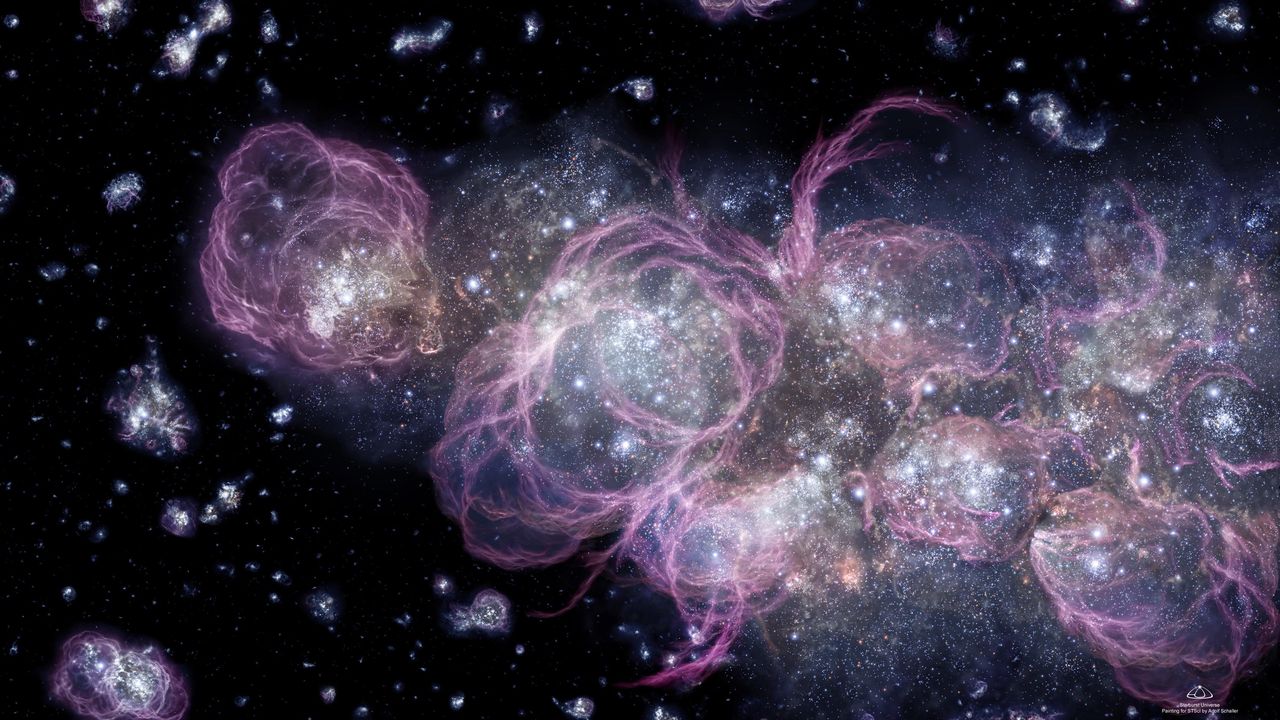
Astronomers look to the sky for objects so elusive and transcendent that they border on the mythological. In this “space Moby Dick” category live the first stars that appeared after the Big Bang. The so-called population III stars shined for a very short time, reached a mass tens or hundreds of times greater than the mass of the Sun, burned at extreme temperatures even by cosmic standards, and were born “pure”, that is, without metals, because they only fused hydrogen and helium.
Today, with the universe being 13.8 billion years old, none of these early stars can be alive. All that remains are the stars formed from the debris they left behind. Fortunately, the most powerful telescopes can detect traces of this first generation. Scientists have identified some candidates, although none of them match all the signs that would allow them to be considered strong evidence of their existence.
That may change. Two recent scientific papers report the discovery of the “cleanest and most pristine” star cluster yet observed. “Heba,” as astronomers have nicknamed it, looks like a tiny dot in the James Webb Space Telescope image, but it meets almost all the criteria a Population III star cluster should exhibit.
Heba, a point that may be a pure star cluster
According to the research, which is still in the process of being peer-reviewed, the light from Geb dates back to when the universe was about 400 million years old, just 3% of its current age, practically in its cosmic infancy. Analyzes detect no metals in the environment and reveal signs of an extremely hot source. Also, its compact size rules it out as an entire galaxy.
Together, these features indicate a very massive population of the III star cluster. The authors rule out other explanations, such as an active galactic core or a collapsing black hole. “They are the most plausible explanation for the observed He II emission, without any satisfactory alternative from other classes of sources or mechanisms,” write the researchers of one of the studies.
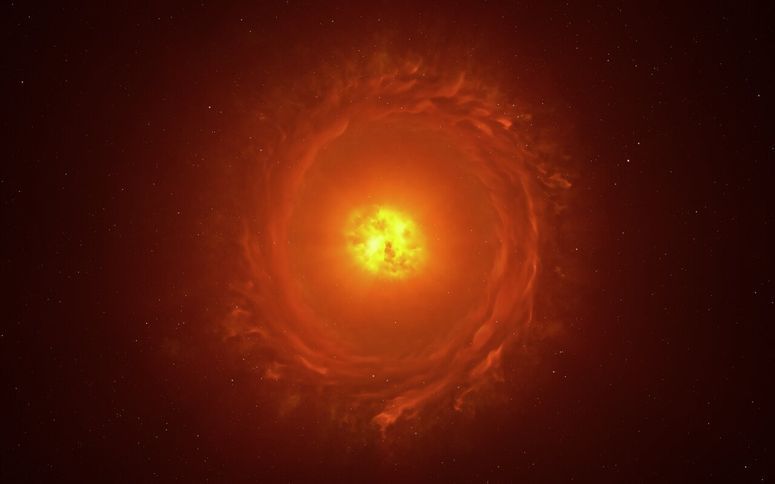
WOH G64 is 160,000 light-years away and is one of the largest and brightest stars. It stopped being a red supergiant and became something rarer.
If Gebo is confirmed, it would exist at a peculiar time in space when the universe was still partially opaque. Neutral hydrogen absorbed most of the ultraviolet light from early stars and prevented it from spreading far. On a large scale, space remained mostly dark. It took another 400 to 600 million years for the universe to acquire the ultraviolet transparency we recognize today.
In the coming years, when new observations confirm the pristine nature of Geb, we will be able to reconstruct for the first time what the first stars in the universe looked like, how they ignited the light in the still opaque space and how they charged the elements that would later form galaxies, planets and life. This will be the first direct evidence of cosmic dawn.