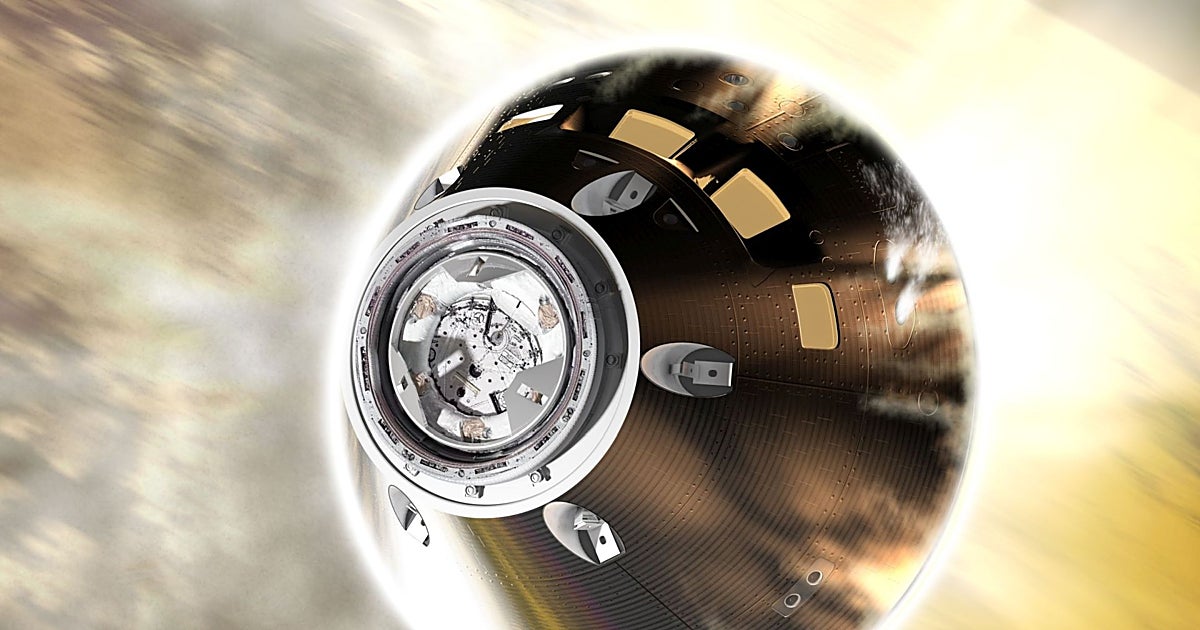
Few imagine the real hell of returning home from the stars. When we watch the happy ending of a space mission on television, as the capsule sways gently under three huge orange and white parachutes, we tend to forget the brutal physical torture the crew members were subjected to. … they just suffered. And in the case of the Artemis II mission, which returned humans to the lunar vicinity half a century after the Apollo era, the experience will push the limits of physiological resistance. Blood, gravity and plasma. This will be the most excruciating 10 minutes of Artemis II.
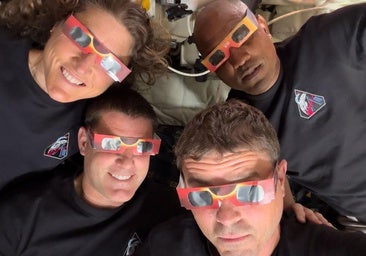
Aboard Orion, NASA astronauts Reid Wiseman, Victor Glover and Christina Koch, as well as Canada’s Jeremy Hansen, will face the mother of all roller coasters in a few hours, in the early hours of Friday into Saturday. A head-on collision with the invisible wall of our atmosphere at a dizzying speed of nearly 11 kilometers per second (about 40,000 kilometers per hour, like flying from New York to Madrid in ten minutes). But what exactly happens inside the human body during this maneuver? This will be what the astronauts will experience on the last leg of their journey, minute by minute.
Minute 0: Hit the Wall and “The Great Silence”
The Orion capsule leaves the cold and vacuum of space and removes the first layers of Earth’s atmosphere. The friction of the air molecules at 40,000 km/h is so strong that it compresses the gas in front of the ship’s heat shield, creating a bubble of super-hot plasma with temperatures exceeding 2,700 degrees Celsius (hotter than molten lava). For infinite minutes, this plasma curtain completely shuts off communication with the dispatcher. This is what is known as “the blackout” or the Great Silence. Inside the ship, the astronauts see an orange and reddish hellish glow licking the windows. Their bodies, after ten days of floating in weightlessness, feel the first jolts. The inner ear, which is responsible for balance and immersed in the confusion of the absence of gravity, begins to send warning signals to the brain.
Minute 2: Gravity Slap and Chest Drop
When entering the densest regions of the atmosphere, the ship slows down tremendously. To avoid burning, Orion follows a specific reentry profile, absorbing two huge deceleration peaks. And that’s when the pain comes. G-force (a measure of acceleration based on Earth’s gravity) increases dramatically.
A steeper entry angle than originally planned is needed to reduce atmospheric transit time and ensure astronaut safety. The decision was made after the heat shield was damaged during the capsule’s return to Earth during the Artemis I mission in December 2022.
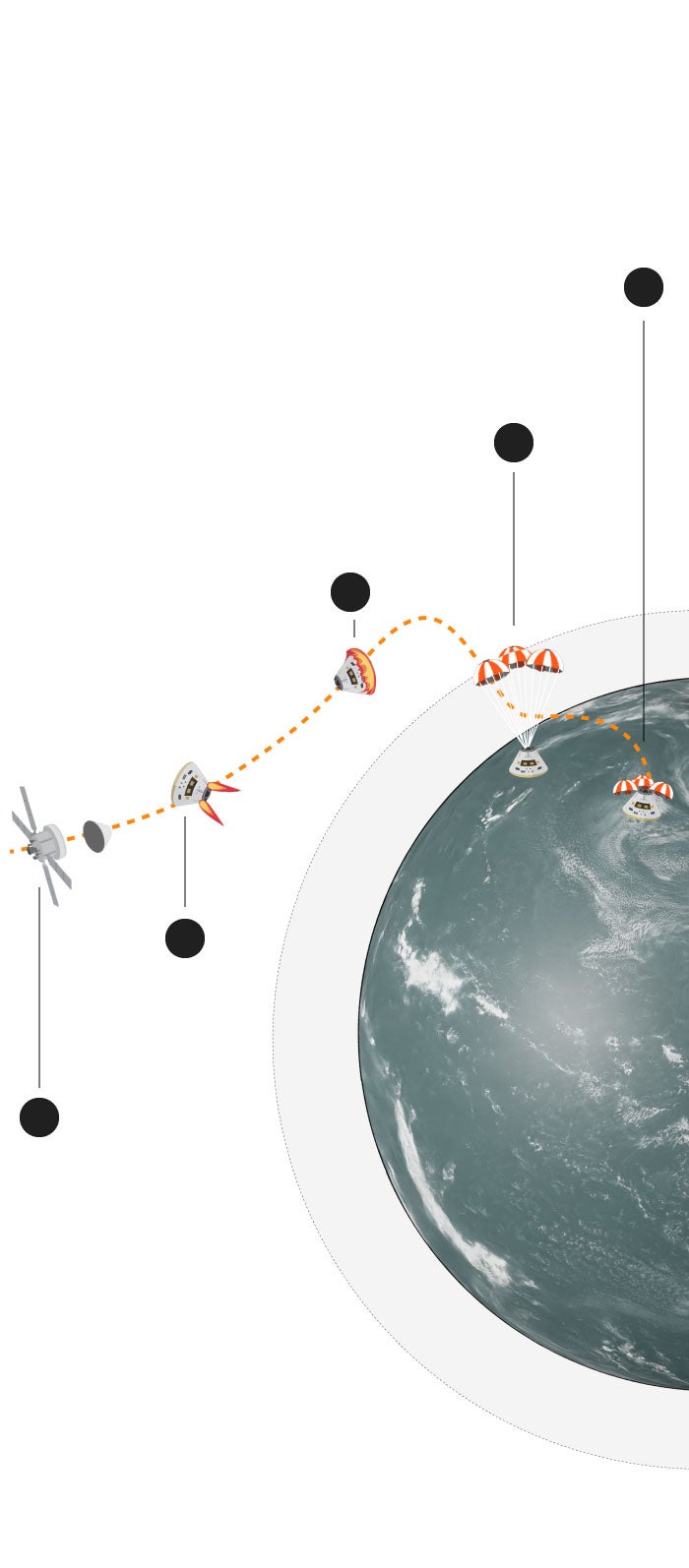
This will be the re-entry of the Orion capsule.
Landing in the Pacific Ocean
Parachute deployment
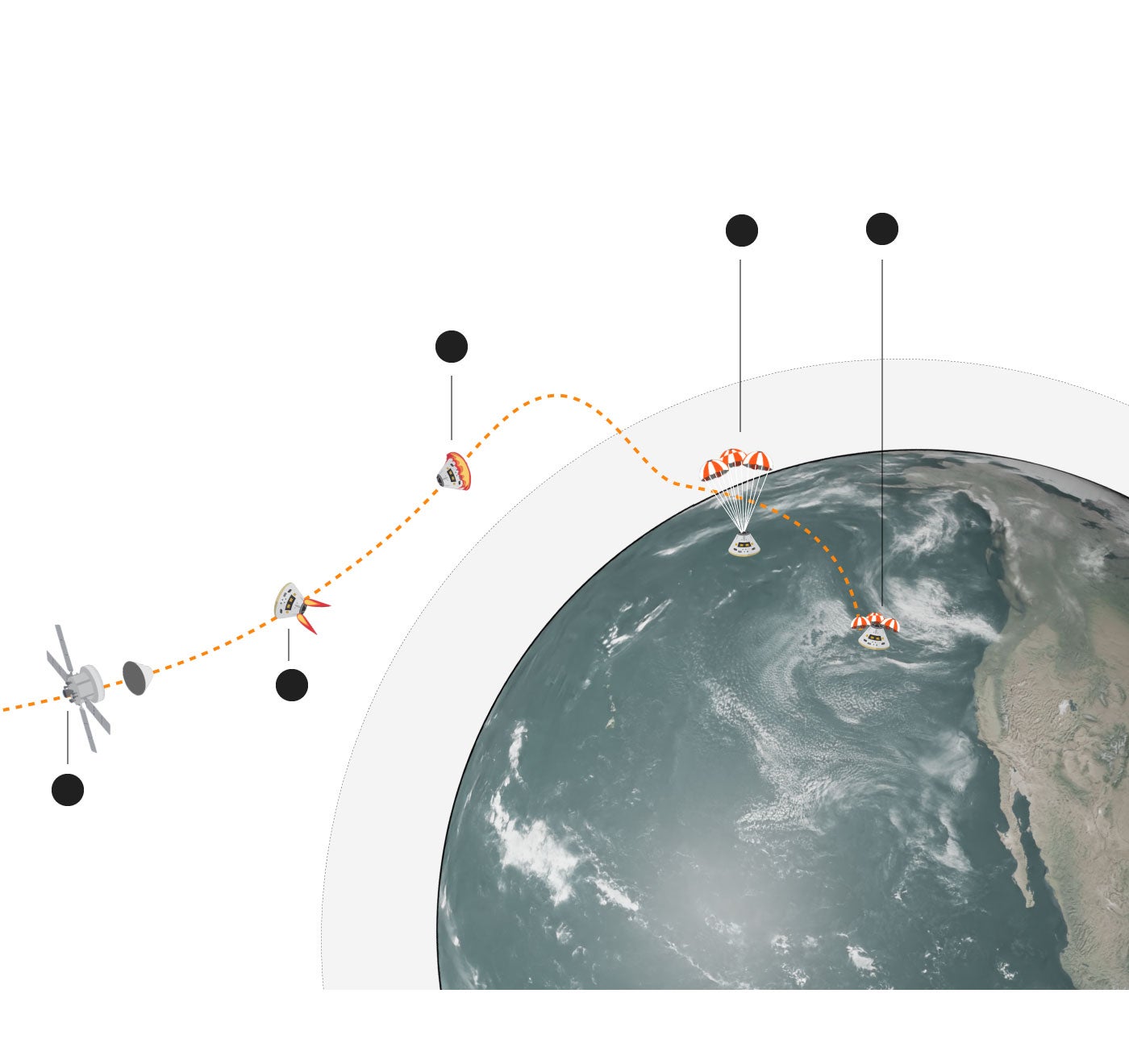
This will be a re-entry into the atmosphere of the Orion capsule
When entering the atmosphere, the force of gravity increases. It was as if a 400-kilogram block of cement suddenly fell on each astronaut’s chest, turning the act of breathing into a titanic task.
Astronauts suddenly feel 5 or even 7 times their own weight moment by moment. It was as if a 400-kilogram block of cement suddenly fell on his chest. Breathing becomes a titanic task; intercostal muscles can barely expand the lungs. At the same time, the blood, which has been “accustomed” to weightlessness for days, pushes furiously to the legs. To prevent the brain from running out of oxygen and the crew from passing out (the dreaded G-LOC), the spacesuits have sealing systems and the astronauts have to exert their abdominal and leg muscles with all their might.
Minute 6: Crashes in the sky and neuronal chaos
The speed has dropped dramatically, but the violence of the journey does not stop. At an altitude of approximately 11 kilometers, the parachute deployment sequence begins. First the small brake parachutes and finally the three main parachutes. Each hole is a sharp and dry “whip” that shakes the backs and necks of the crew. At this moment, the body suffers from complete disorientation. The brain, which has spent more than a week adapting to three-dimensional buoyancy, now receives the precise “up” and “down” signals created by Earth’s gravity. Which causes what is known as space sickness or space adaptation syndrome in the reentry phase. The result: severe nausea, cold sweats, and a profound sense of vertigo.
Minute 10: Impact on the ocean
The ship landed in the Pacific Ocean off the coast of California at a speed of about 30 km/h. -, isalowlowspeedafteraveryfatigue From here, every astronaut will feel that his arms and legs are made of lead.
Simply lifting your head or trying to stand up when rescuers arrive will require an incredible amount of effort. It seems incredible, but in just ten days the body forgot to cope with the burden of its own existence.
Evacuation teams, deployed two hours before landing, will then begin to operate. U.S. Navy rescue helicopters aboard the USS John P. Murtha will conduct search and rescue operations. NASA has asked the public to avoid the landing zone due to the risk posed by the debris from the spacecraft. Lead mission manager Jeff Redigan warned that the return of the four crew members from the ground would not be seen because of the risk of falling debris such as parachutes.
If all goes as planned, the Artemis II crew will be rescued from the capsule, which will float above the ocean, in about 30 to 45 minutes. The four astronauts will pave the way for the Artemis IV mission to return and land on the moon in late 2028, nearly 60 years after humanity last set foot on its surface.