
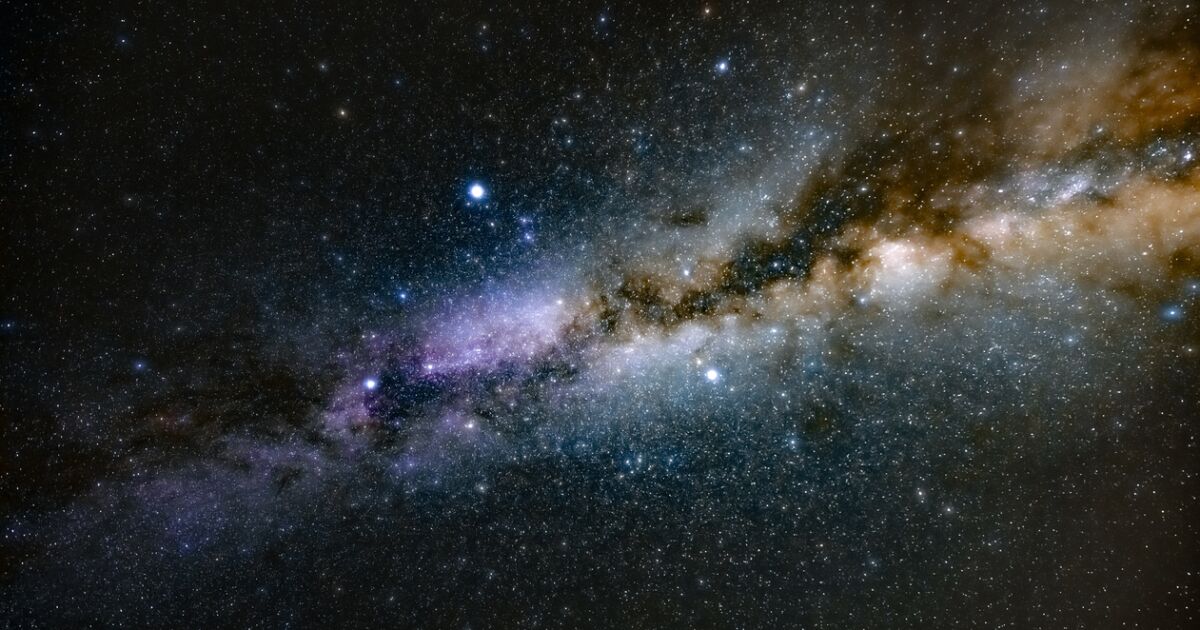
How NASA is using space dust to discover the Milky Way
How scientists at the National Aeronautics and Space Administration (NASA) will use these components is more unique than just taking samples. Rather, it will be indirect.
They will use one of Rome’s Nancy Grace Space Telescope’s main programs, called the Galactic Plane Survey, to map the galaxy end-to-end, about 20 billion stars, nearly four times as many as have been mapped to date.
Scientists will use the star data and map the dust through which light passes to build a more complete picture of the Milky Way’s structure, star formation and the origin of the Solar System.
“With Roman, we will be able to transform existing digital representations of the Milky Way into more data-driven models using new drivers of the three-dimensional distribution of interstellar dust,” said Catherine Zucker, an astrophysicist at the Harvard-Smithsonian Center for Astrophysics in Cambridge, Massachusetts.
Why are dust and gas important?
NASA explains that these elements are both the seeds of new stars and the “leftover bits of stars that died long ago.” They are scattered among the stars known as the interstellar medium.
“Exploring the interstellar medium with observatories such as NASA’s upcoming Nancy Grace Rome Space Telescope will provide new insights into the galactic dust recycling system.”
Scientists will use different methods of studying the wavelengths of light to obtain characteristics of the distances between one star and another. In addition, they will be able to learn about the composition of dust and clouds that form in space in order to investigate the physical processes responsible for changing properties.
“Clues hidden in starlight by dust provide clues about how much dust exists between a star and us. Combining observations of many stars allows astronomers to create detailed 3D dust maps.”
This will allow scientists to create a model of the Milky Way that shows what it looks like from the outside and can be compared to other galaxies to provide a cosmological view of evolution.
However, these studies have not yet begun, as the Rome Telescope is scheduled to launch no later than May 2027, and staff will be working on a possible early launch, which could take place in the fall of 2026.
NASA also uses X-rays to study galaxies
NASA’s Chandra X-ray Observatory has observed several galaxy clusters with extraordinary clarity because it captures the hot gas stores between the clusters that emit this type of radiation.
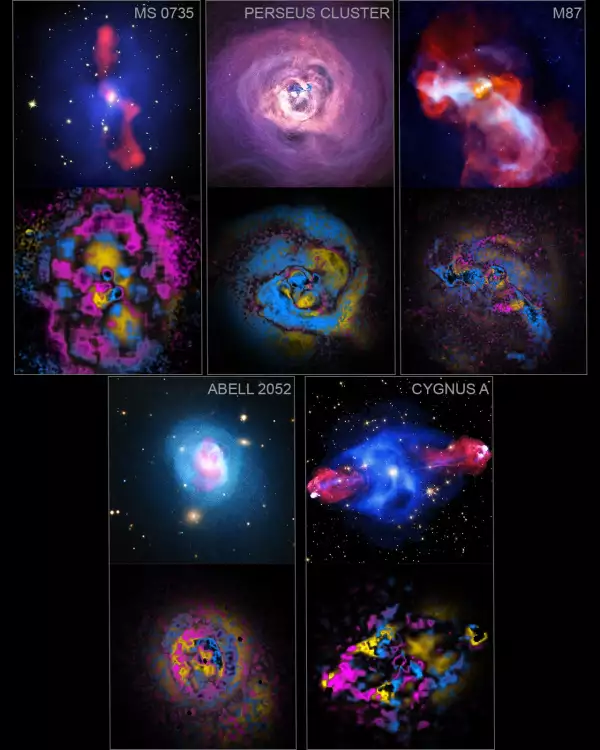
Clusters of galaxies are the most massive objects in the universe, held together by gravity and containing up to thousands of individual galaxies and vast deposits of superheated gas that emit X-rays, making them visible. NASA considers them indicators of galaxies, stars and black holes, as well as a source of information about the evolution and growth of the universe itself.
Scientists have developed an image processing technique to analyze X-ray data called “X-ray arithmetic” that identifies radiation energy at different wavelengths and creates structures visible in the images with different colors depending on their type.
Recently, the Chandra X-ray Observatory and the Hubble and Webb space telescopes managed to study a galaxy at the center of which is a black hole twice the size of the Milky Way.
Arithmetic X can be used to understand the effect of black hole explosions on how much energy they release into the surrounding gas and how often they occur.
(Tattranslate)nasa via lactea(T)via Lactea 3D NASA(T)via Lactea Nsa


