
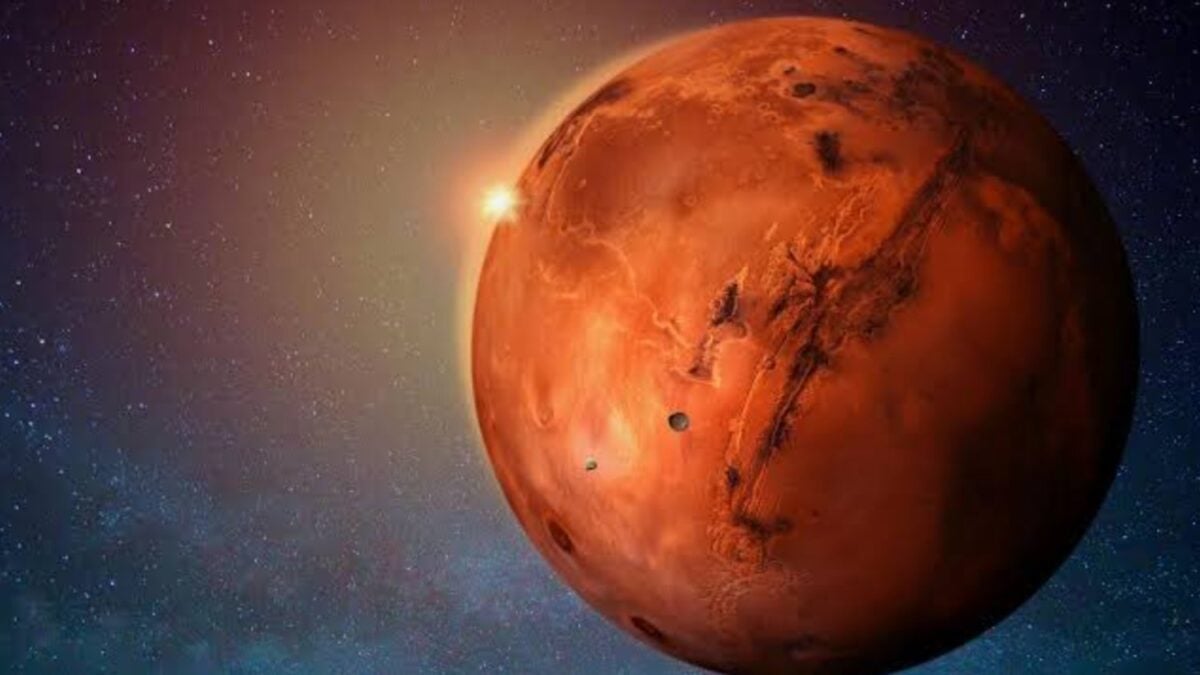
Colonizing Mars has always been seen as humanity’s next great leap, but one challenge remains the same: how do we build safe homes on the inhospitable planet without depending on a constant supply of resources from Earth? Carrying heavy materials will make any mission impossible. Thus, new research opens up a revolutionary way: using terrestrial microorganisms to produce “biological cement” from the Martian soil itself.
Researchers from the Polytechnic University of Milan presented at Frontiers a method that combines two bacteria – Sporosarcina pasteurii and Chroococcidiopsis – to create a sustainable material capable of becoming walls and residential modules. The key lies in a natural process known as biomineralization, the very thing that formed reefs and mineral structures on Earth millions of years ago.
The first human colony on Mars is already in the works, and a small group of pioneers is expected to inhabit a self-sufficient city in the next decade, marking a new chapter in the history of space exploration. 🚀 pic.twitter.com/H2jlJxh5Ap
— Jaime Maussan (@jaimemaussan1) June 17, 2025
Two microbes, one goal: turn Martian dust into concrete
Sporosarcina pasteurii produces calcium carbonate through urealysis, which allows for the consolidation of loose soils. Chroococcidiopsis, a cyanobacterium able to survive in extreme conditions, provides oxygen and creates a protective environment that promotes the growth of its companion. Together, they create a “biocement” that can be mixed with Martian regolith to print three-dimensional structures directly on the red planet.
In addition, cyanobacteria produce polymers that protect Sporosarcina from strong UV radiation. This microbial cooperation not only forms the basis of building material, but can also be integrated into life support systems: oxygen for breathing and ammonia for fertilizing crops in future Martian gardens.
Build without sending cargo from Earth
Mars is a cold world with a thin atmosphere and intense radiation. Building a shelter there is not just “building a house”: it requires thermal insulation, protection from energy particles and airtight structures. If the bricks can be produced locally, the logistics change completely.
NASA expects the first human settlements to appear in the 2040s. Until then, the technique could allow for self-healing modules printed on Martian soil, lowering costs and freeing up space for permanent bases.
What is missing to turn the theory into a real colony
The main limitation is that the system cannot yet be tested on real Martian soil, as the mission to return the samples faces delays. While we are working with regolith simulators. It will also be necessary to test the process under real conditions: low pressure, extreme temperatures and radiation.
If it passes these tests, future astronauts will be able to build houses, laboratories, warehouses and even agricultural areas without waiting for ground supplies. A decisive step towards the self-sufficiency of Mars.
Source: Infobae.


