
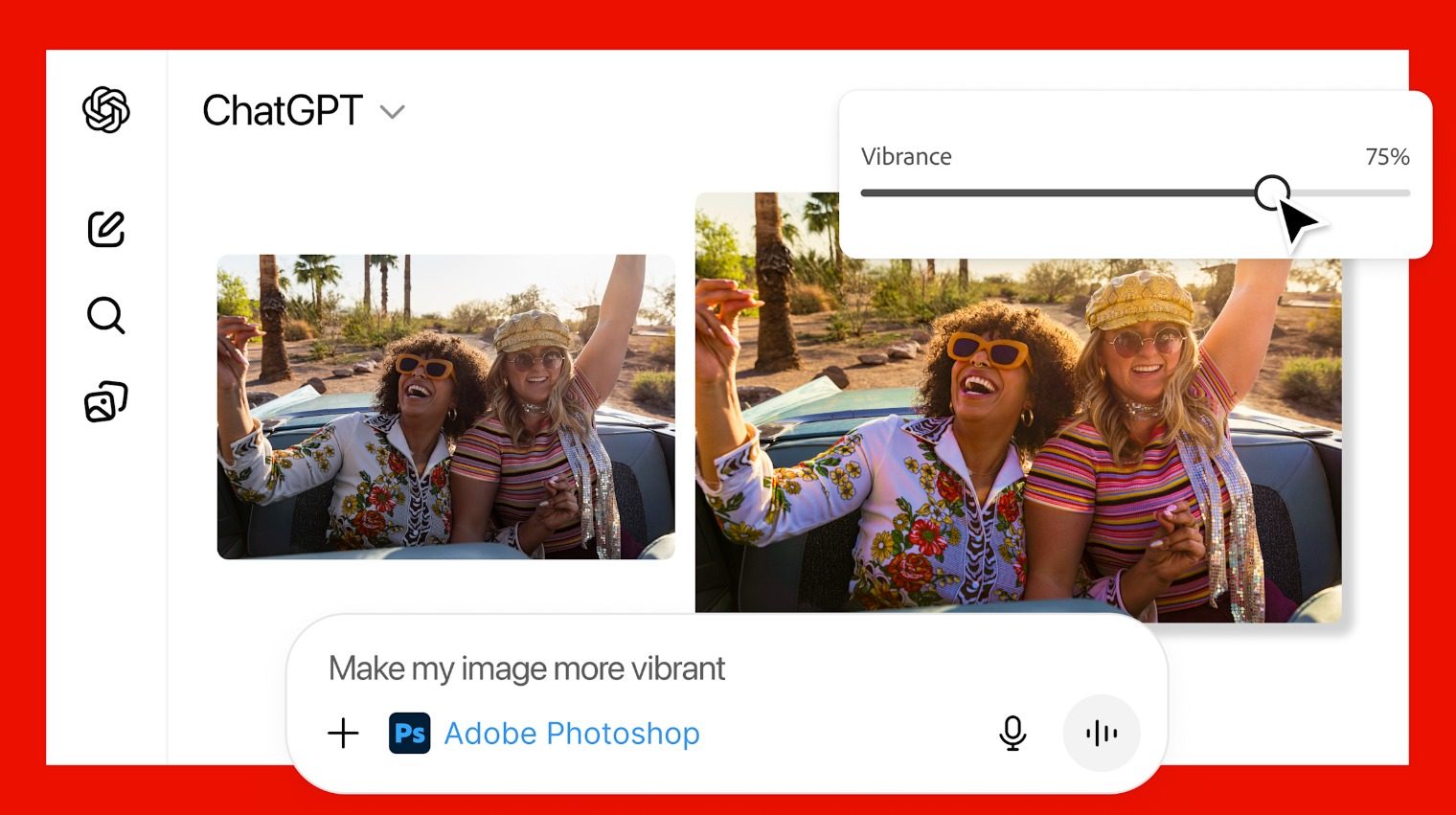
In a move that represents one of the most significant milestones in the convergence between major creative software platforms and conversational AI, Adobe announced its flagship applications Photoshop, Acrobat and Adobe Express now fully integrated and accessible directly from ChatGPT. Starting today, users of the OpenAI platform can access these powerful tools without leaving the conversational interface, turning what was a text-based assistant into an integrated authoring and productivity environment.
The technical integration at the heart of this alliance is particularly complex and deserves attention. Adobe used the Model Context Protocol (MCP), an open standard recently released by OpenAI, to create a seamless connection between its apps and ChatGPT. This protocol acts as an intelligent intermediary that allows ChatGPT to not only communicate about design or editing, but also actually perform real-time changes in Photoshop, create PDF documents with Acrobat, and launch creative projects in Adobe Express.
What is particularly interesting about the implementation is how ChatGPT dynamically adapts its interface according to the user’s requests. When you ask to adjust the brightness of an image, ChatGPT will show specific controls for exposure, shadows, and highlights. If you want to apply visual effects, the interface will change to show options like antialiasing and tricolor tones. This contextual adaptation shows that Adobe has invested significant resources in understanding how ChatGPT can replicate the logic of its professional software, simplifying an already complex interface.

Aubrey KettleVP of Developer Platform and Partner Ecosystem at Adobe, explained the integration philosophy in a way that reveals both the ambition and the limitations: “We build the Lego blocks that are the MCP tools, and we build detailed instructions, and then ChatGPT decides what to do. Sometimes it does what we want, and sometimes it doesn’t. Such is the nature of the indeterminate.” This honesty about the limits of generative AI is refreshing at a time when many companies are overselling the capabilities of their AI systems.
For OpenAI, this partnership is easily the biggest coup in its efforts to transform ChatGPT from a conversational assistant to a true operational software platform. Since last October, when OpenAI announced the Apps SDK, the company has gradually included third-party apps such as Spotify, Booking, Canva, and now Adobe. But Adobe’s integration is qualitatively different: it’s not just about accessing third-party services, but also about getting ChatGPT professional creative capabilities that previously required expensive licenses and steep learning curves.
The business model behind this integration is fascinating from multiple perspectives. For Adobe, this represents a defensive strategy against the possibility of OpenAI or its competitors developing their own image and document editing capabilities without relying on Adobe. In fact, Cattell was clear about this potential problem: “OpenAI has its own image generation. However, Adobe doesn’t see it that way.” The statement was followed by a reference to the “natural affinity” between the workflows that OpenAI aims to enable and Adobe’s “world-class” capabilities.
For users, especially those who are not professional designers, the integration promises to democratize access to tools that have historically been inaccessible due to their cost and complexity. Now a user can tell ChatGPT to “create a dance party invitation” in natural language and the system will automatically generate an image, edit it in Photoshop if necessary and possibly send it via Acrobat as a PDF. However, for creative professionals, the conversation is more complicated. Will this integration replace your work? Or will it be another auxiliary tool in your arsenal?
Cattell cautiously stated that “Photoshop, Acrobat, and Adobe Express on the web are where you go when you want more power, precision, and control.” This suggests that Adobe sees the integration with ChatGPT not as a replacement for its professional product, but as a gateway that will eventually lead users to the full tools. This is a classic conversion strategy: getting initial attention and use of ChatGPT, then gradually drawing users into the deeper Adobe ecosystem.
The MCP’s technical architecture also has broader implications. OpenAI has released the code as open source, meaning that other platforms that accept the MCP protocol can theoretically connect to specialized tools in the same way. This opens up the possibility that in a year or two ChatGPT will become not just an artificial intelligence assistant, but a real “operating system” of applications, where users will be able to run everything from professional creative tools to reservation, payment and business management services.
However, this expansion also raises questions of privacy, security and consolidation of technological power. When a user connects Photoshop to ChatGPT, what data about their creative projects goes to OpenAI? How are confidential files handled? What happens if OpenAI decides to change its privacy or access policy? Although Adobe and OpenAI have clearly implemented HTTPS security protections and other standards, the concentration of multiple applications on a single platform creates security risks that deserve further monitoring.
Adobe’s announcement also points to a broader pattern in the tech industry: consolidation around major AI platforms. Microsoft is integrating tools into Copilot, Google is doing the same with Gemini, and now OpenAI is becoming the “dominant host” where other software vendors want to host their services. This is likely to lead to an ecosystem in which three or four tech giants effectively control access to most of the productivity tools that society uses.


