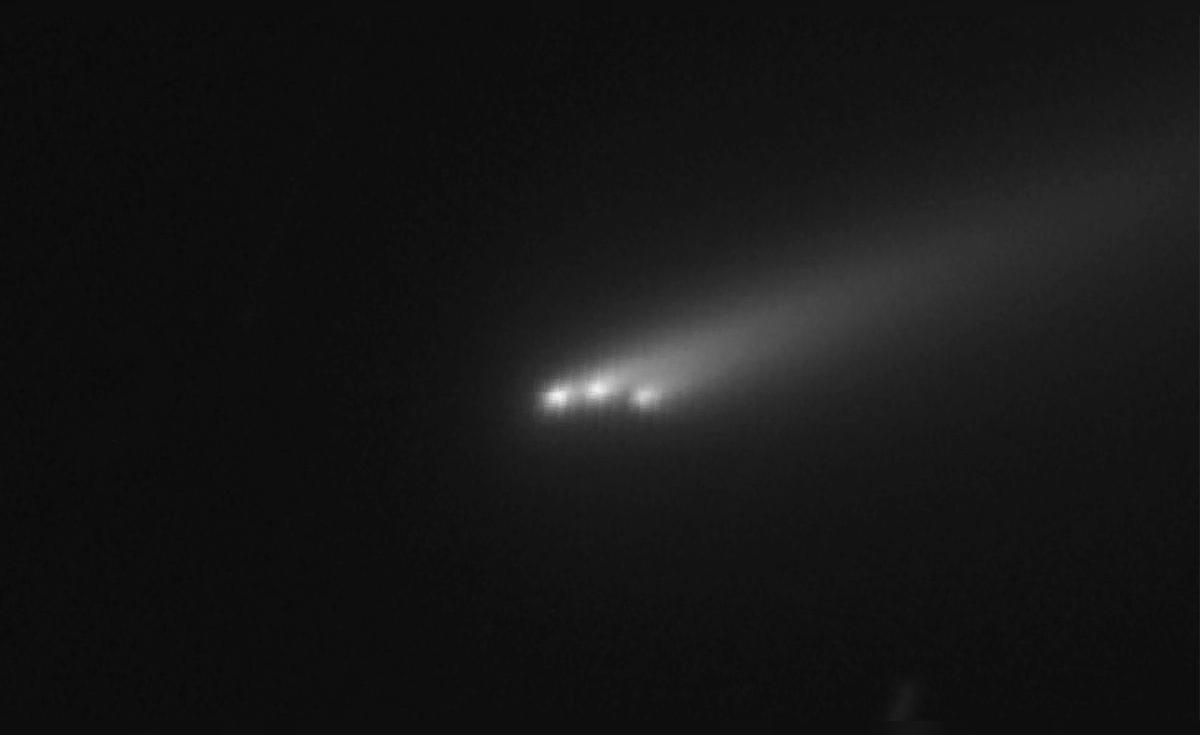
He comet C/2025 K1 According to the latest images, it was recorded as slowly disintegrating after the explosion as it passed the Sun in early November. Known as the “other ATLAS,” this object shares its name with an interstellar comet because both were detected by the telescope system Asteroid Collision Last Warning System (ATLAS).
On October 8, she reached her goal perihelion (closest point to the Sun), approaching 50 million kilometers from our star. The comet remained invisible until earlier this month, when an unusual golden glow appeared in its coma and tail. C/2025 K1 (ATLAS) and 3I/ATLAS Despite having the same name, they are not related in any way.
The End of Comet C/2025 K1 (ATLAS)
Michael Jaeger is an Austrian astrophotographer who has been closely following comet C/2025 K1 since it fragmented on November 13, and presented an animation showing the comet’s fragments slowly disintegrating. Astronomers did not expect the comet to survive its approach to the Sun, but the first images showed that it was undamaged. However, its brightness suddenly increased and it began to break into three pieces.
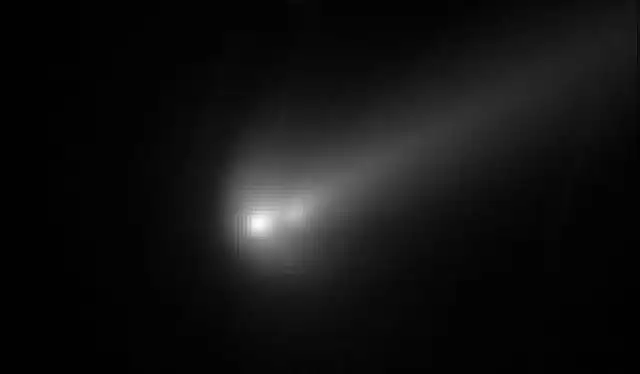
The comet began to show sudden brightness in early November. Photo: Michael Jäger
“After a sudden increase in brightness in early November, we were able to observe the breakup of this comet into three brighter fragments over the past two weeks,” Jaeger told Spaceweather.com. “The animation shows it on November 12, 14, 18, 19 and 20.”
Fragments of the comet will still be visible in the Leo constellation (northern hemisphere) to anyone with a decent telescope or stargazing binoculars.
Messengers of the Solar System ATLAS
Comet C/2025 K1 is just one of many comets discovered by the NASA-funded system, which has been scanning the sky since 2015 with telescopes in Hawaii, South Africa and Chile. Over the years, ATLAS has identified many comets, including C/2024 G3, which was photographed by astronauts on the International Space Station, and Comet Halloween, known for its proximity to the Sun.
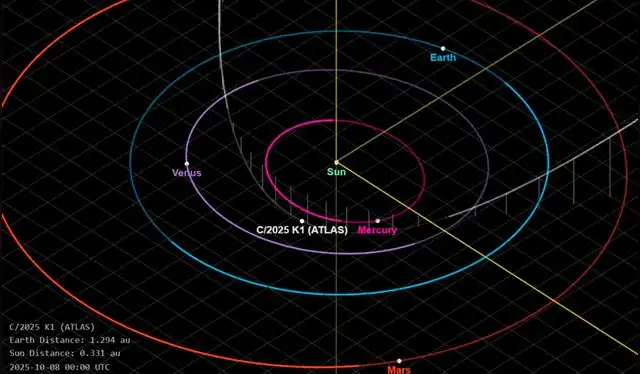
C/2025 K1 (ATLAS) reached its closest point to the Sun on October 8 and came more than four times closer to our home star than 3I/ATLAS. Photo: NASA/JPL
The most famous is 3I/ATLAS, which originates from a star system possibly long before our solar system formed. This comet, which flew close to Earth in October, is now on its return journey outside the solar system, and its closest point to our planet will be reached on December 19 at a distance of 270 million kilometers.
Although some theories suggest that 3I/ATLAS may be an extraterrestrial craft, the astronomical community agrees that this is not the case. The future of ATLAS comets promises more exciting discoveries.