
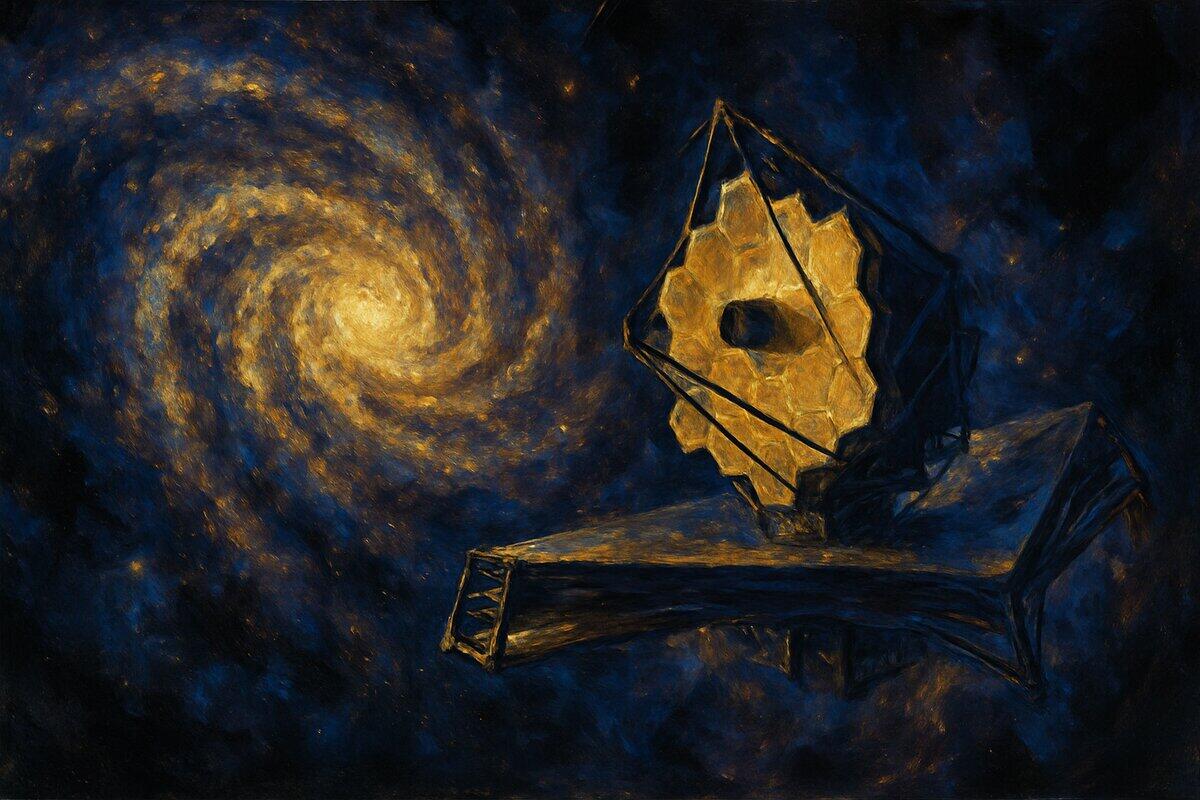
Space telescope Nancy Grace Romanone of NASA’s most ambitious projects, has completed its core assembly, marking a milestone on the way to a launch scheduled for late 2026 and May 2027. This new astronomical instrument promises to fundamentally change what we know about space, thanks to a unique combination of advanced technology, a wide field of view and unprecedented infrared sensitivity.
Complete architecture ready for final testing
On November 25, 2025, NASA specialists connected the two main sections of the telescope at the Goddard Space Flight Center in Maryland. This integration marks the beginning of the final phase of testing before transfer to the Kennedy Space Center, where it will be prepared for a trip to space aboard a SpaceX Falcon Heavy rocket. Roman’s final destination will be the second Lagrange point, a million miles from Earth, from where he will observe the universe with exceptional stability and clarity.
A mission with a dual purpose: science and technology
The Roman telescope is designed for massive and detailed observation of large areas of the sky. During his main five-year mission, he will study stars, galaxies, black holes and exoplanets. Unlike telescopes like Hubble or James Webb, Roman will combine a wide-angle view with sensitivity similar to that of those telescopes, but capable of recording data hundreds of times faster. It is supposed to collect up to 20 petabytes of datawhich will allow conducting parallel research of the international scientific community.
The telescope includes two main instruments: A wide field tool and Coronagraph. The first is a 288-megapixel camera that will take pictures of regions of the sky larger than the lunar disk, allowing for millions of objects to be observed with each shot. The second, the coronagraph, is a key technology demonstration of the future of exoplanet observation.
Exploring worlds beyond starlight
The coronagraph has a complex mission: block the starlight to be able to see more clearly the faint light reflected by the planets revolving around them. It’s like trying to see a firefly next to a lit lighthouse. Thanks to this instrument, astronomers will be able to obtain direct images of cold, ancient giant planets that usually escape modern methods, and to probe the dusty disks surrounding other stars.
For the first 18 months, the coronagraph team will conduct pre-set observations, but NASA may expand its use depending on results and interest from the scientific community.
Three great overviews to map the universe
The Wide Field Instrument will conduct three main surveys, which will occupy 75% of the mission’s time. Each of them is designed to answer fundamental questions about the structure and evolution of the universe.
The High latitude wide field survey will combine images and spectra for detection more than a billion galaxiesstudy of the distribution of art dark matter and monitor the formation of structures over time.
The Survey in the time domain of high latitudes It will repeatedly observe the same part of the sky, creating a kind of movie of the changing universe. This will allow us to study the evolution of supernovae, changes in galaxies and other variable signals, keys to understanding dark energythat mysterious force that accelerates the expansion of the universe.
third, A time-domain survey of the Galactic bulgefocus on the center of the Milky Way, looking for events gravitational microlensing which detect exoplanets, solitary stars, wandering black holes and orphan planets, those free-floating in a galaxy without a parent star.
Science for everyone, without barriers
The remaining 25% of the mission’s time will be devoted to observations offered by the astronomical community. Within this framework, The program of the general investigator This will allow teams around the world to freely access data without exclusivity periods. This openness encourages collaboration and multiplies opportunities for discovery.
One of the first projects selected in this space is An overview of the galactic planewhich will analyze star-populated regions in our galaxy.
Honoring a pioneer of astronomy
The telescope is named after him Nancy Grace Romanthe first chief astronomer of NASA and one of the main promoters of space telescopes. His vision was key to the development of Hubble and the promotion of astronomy as an accessible science. His legacy lives on in this new tool that promises to open the door to decades of discovery.
The Roman telescope will not only observe, but also document the era of changes and unsolved mysteries: from the nearest stars to the far corners of the observed universe. Your journey has only just begun, but expectations are already pointing to a new stage in the understanding of space.


