

Discover the fascinating science behind the images of each month in NASA’s 2026 calendar. This new year highlights an image from Peru, as well as photos related to the space agency’s scientific research.
Rays of clouds over the coast of Peru

These low clouds over st Pacific Ocean near Peru they could evoke snowflakes under a magnifying glass or tall mountain peaks seen from above. Because of their characteristic radial shape, they are called actinoform clouds from the Greek word for “lightning”. Stars photo in April in NASA science calendar.
NASA researchers use satellite data to study clouds that gather, move around the planet, and disperse to gain insight into this important element of Earth’s climate and energy budget.
Some clouds reflect the sun’s energy and reflect it back into space, while others act as an insulating blanket for Earth, trapping heat closer to the ground. This image was taken on July 14, 2024 using the Ocean Color Instrument aboard NASA’s Plankton, Aerosols, Clouds, and Ocean Ecosystems (PACE) satellite.
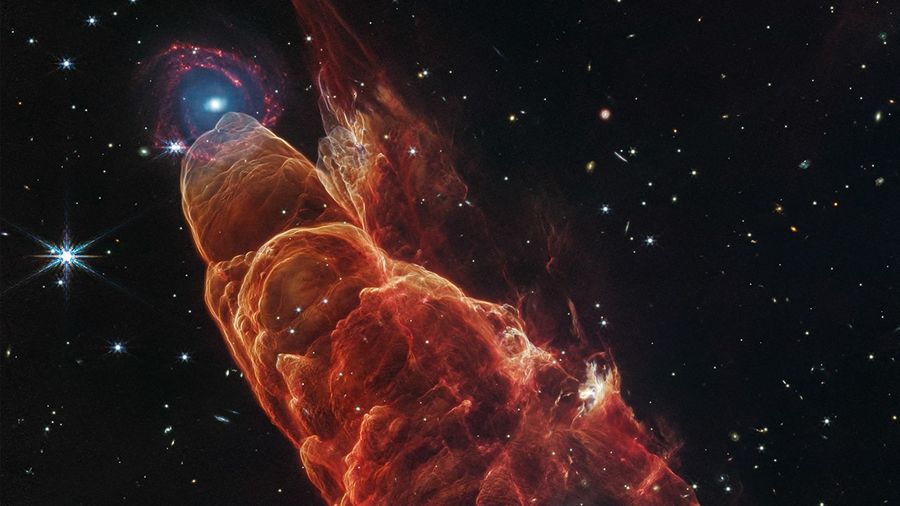
The true nature of the space tornado
NASA’s James Webb Space Telescope observed Herbig-Haro 49/50, a ejection of material from a nearby star that is still in the stage of formation, in high resolution near and mid-infrared in August 2024.
The observation provides detailed clues about how young stars form, including the early stages of low-mass stars like our Sun, and how the activity of the jets they emit affects their environment.
In addition, The James Webb telescope saw this Herbig-Haro object nearby aligned in the sky with a more distant spiral galaxy in the background. The spiral galaxy has a distinct central bulge, shown in blue, which shows the location of the oldest stars. The bulge also shows signs of “side lobes”, suggesting it may be a barred spiral galaxy.
Unlocking the secrets of aging and disease
While NASA prepares to return to the moon It is vital to study the influence of the space environment on the formation of blood clots in human blood. To investigate this, the researchers used a model system that mimics megakaryocytes, specialized cells in the bone marrow that are responsible for producing platelets.
The development and functioning of these cells was observed in cultures aboard the International Space Station as part of the Megakaryocytes in Orbit in Outer Space and Near Earth (MeF1) study.
After returning to Earth, the researchers analyzed the cells using scanning electron microscopy and color images.
A close encounter with an asteroid

On April 20, 2025, NASA’s Lucy spacecraft captured this image of asteroid Donaldohanson as Lucy flew through the main asteroid belt on its way to its final destination in Jupiter’s Trojan asteroids.
Asteroids, the rocky remnants that formed during the birth of our solar system, can help us understand the origins of our planets and other small bodies. Donaldahanson was thought to have formed from the collision of two smaller bodies known as a contact binary, but the strange shape of the connection between the two lobes suggests a more complex geology that scientists can now study in detail thanks to data collected by the Lucy instruments.
A crater on the moon
Morning sunlight illuminates the west wall of the unnamed crater, leaving deep shadows on the ground and inside. The image was taken on August 30, 2023 by the Lunar Reconnaissance Orbiter (LROC).
LROC is a three-camera system and one of seven instruments aboard NASA’s Lunar Reconnaissance Orbiter (LRO) mission, which launched in June 2009 and continues to orbit the Moon.
LRO’s primary mission was to create a 3D map of the lunar surface to help identify future landing sites and resources such as polar ice, study the radiation environment and test new technologies, all in anticipation of future human and robotic exploration.
JURA
Published: 12/12/2025
(Tattranslate)Calendario Citífico(T)nasa


