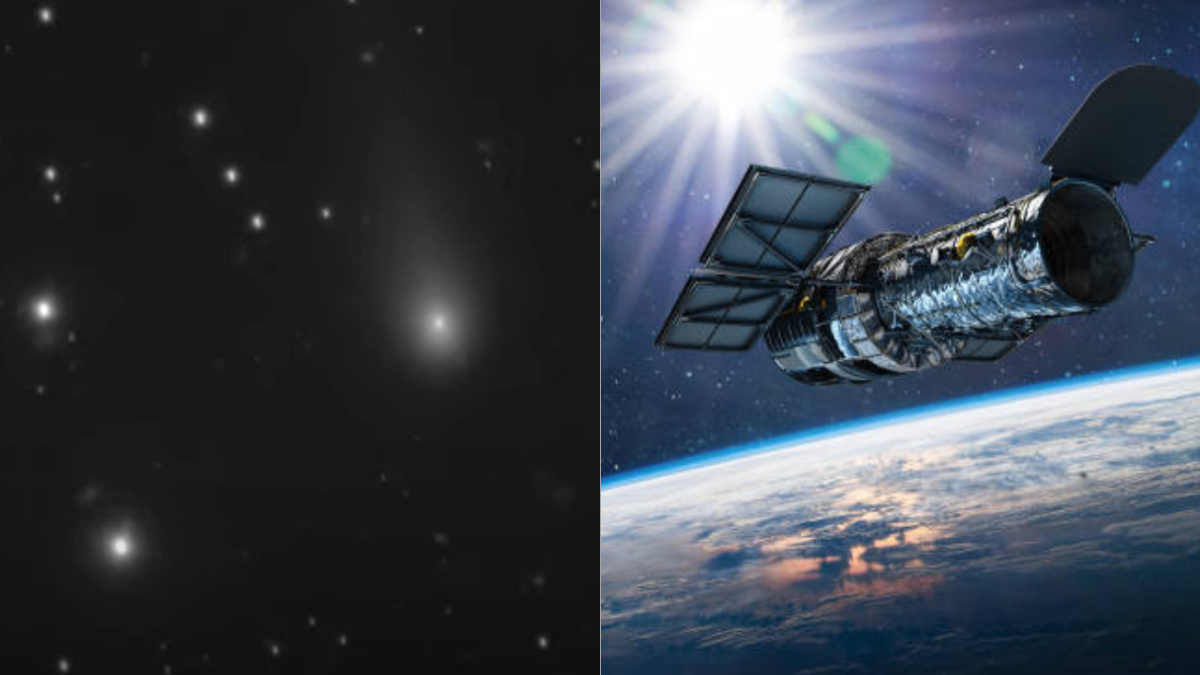
Discovery of comet 3I/ATLAS in July 2024 revived the interest of the scientific community in the study of materials that formed outside our solar system.
READ ALSO
Although he the object is already moving away quickly Having reached its closest point to the Sun in October 2025, a study by the Interstellar Research Initiative shows that reaching it is still technically possible.
The proposal proposes a mission that, if launched in 2035, would intercept 3I/ATLAS around 2085, breaking the speed and distance records in the history of spaceflight.
The Obert Effect: The Gravitational Catapult
The key to this mission lies in the Obert effect, an aerospace principle that states that a rocket engine produces more usable energy the faster the craft moves when it’s on. To reach the required speed, the probe must first fly past Jupiter to be redirected to the Sun.
After reaching perihelion (closest point to the star), the spacecraft ignited its solid-fuel engines. This momentum, added to the extraordinary speed achieved by the Sun’s gravity, would allow the probe to reach the comet at a distance of 732 astronomical units (AU) from the Sun. To put that in perspective, that’s more than four times the distance traveled by Voyager 1 in nearly half a century.
Engineering tasks
Carrying out a maneuver of this type is associated with unprecedented risks. The spacecraft must fly just 3.2 solar radii from the star’s center, encountering temperatures in excess of 1,400 °C. The researchers propose using advanced carbon composite heat shields and airgel layers that exceed the shielding capabilities of current missions such as the Parker Solar Probe.
The proposal involves using a refueled SpaceX Starship rocket in orbit to launch the 500-kilogram interceptor. However, there is controversy over whether the effort warrants a scientific return. Due to the high speed, the encounter would be a fleeting flight. In addition, the new Vera C. Rubin Observatory in Chile promises to detect about one interstellar object per year, which could reduce the exclusivity of 3I/ATLAS.
The future of interstellar exploration
While agencies like ESA are planning missions like the Comet Interceptor for 2028 — which will wait in space for nearby targets to appear — Obert’s solar maneuvering technique remains a valuable option. It will serve not only to chase interstellar visitors, but also to study the hypothetical Ninth Planet or the boundaries of the Kuiper Belt. For now, 3I/ATLAS continues its journey into the void, leaving open the question of whether humanity will one day be able to decipher the secrets it holds within.
*This content was transcribed using artificial intelligence based on information from DW.
READ ALSO